State of the Hub 2026: Value, integration, and what comes next for newsroom sustainability
Each year, the News Revenue Hub digs into network-wide data, industry research, and client outcomes to surface the trends shaping newsroom sustainability. We shared our latest findings during this year’s State of the Hub presentation earlier today.
Below, we’ve summarized the key insights and takeaways. It’s a longer read, but organized by topic for easy navigation. Like every State of the Hub, this recap is designed to be practical and forward-looking. After all, analyzing the past is only useful if it informs how we act in the future.
This year’s presentation was guided by a question we ask every newsroom — and ourselves: What is your value?
In a crowded, fast-paced, AI-influenced information environment, clarity of value isn’t optional. It’s essential to audience trust, growth, and revenue. Throughout the presentation, we highlighted how strong value propositions show up in product strategy, revenue systems, engagement tactics, and organizational focus.
2025 Hub network highlights
Across the Hub network, 2025 was a year of measurable growth and system-building:
- Hub organizations saw on median +10.3% year-over-year revenue growth (higher if they’re working with our consulting team).
- Together, Hub newsrooms raised $33 million from 206,000 contributors.
- News organizations saw an 13x average return on investment from Hub consulting support in 2025
We also saw continued maturation across newsroom revenue programs — including more diversified strategies, expanded automation, and stronger infrastructure behind fundraising and audience development.
Our updated value proposition: Beyond membership
When the Hub began, much of our work focused on launching and strengthening membership programs. A decade later, that work remains important, but it’s no longer sufficient on its own.
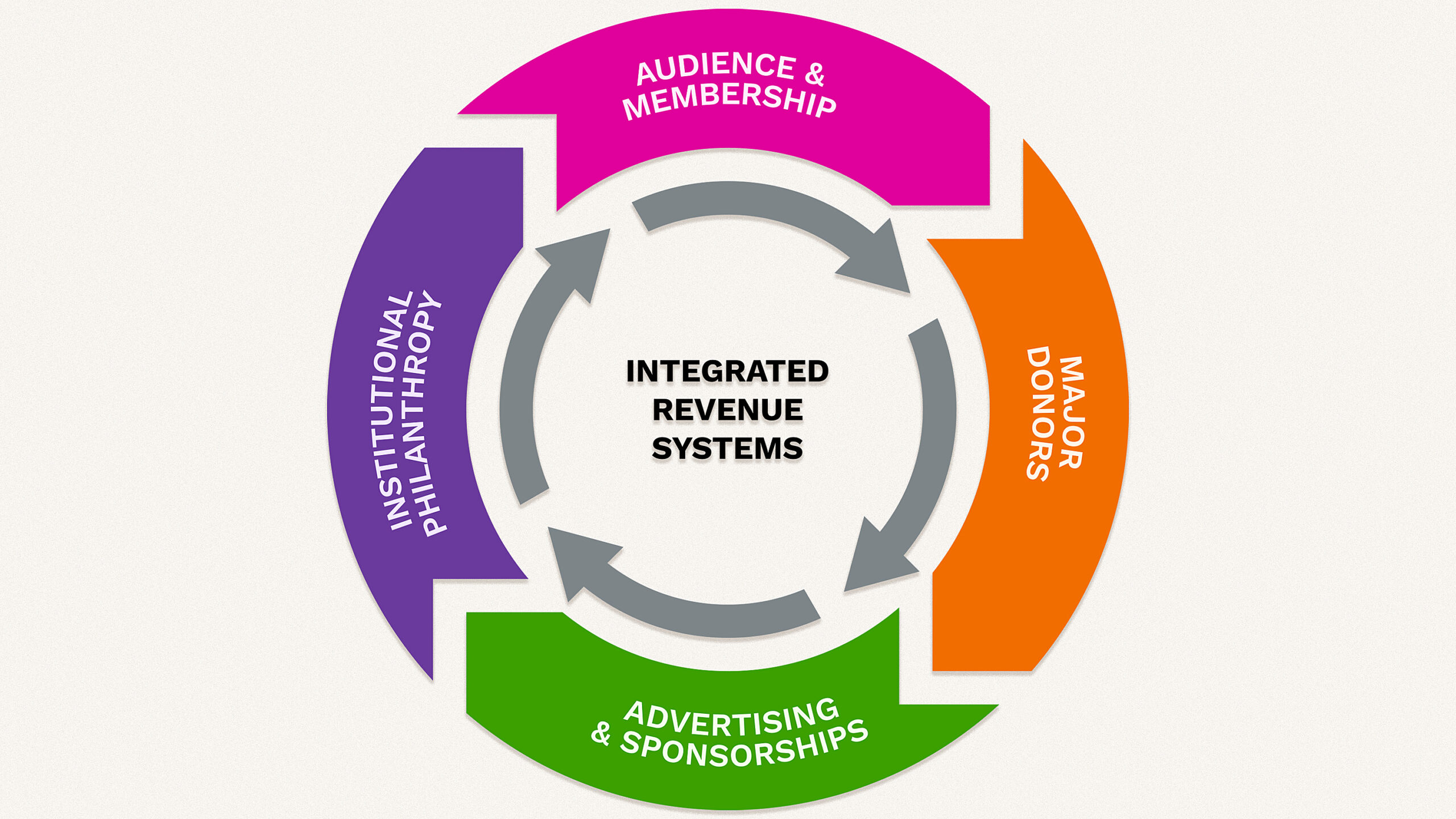
Sustainable journalism is funded by integrated revenue systems — not a single stream. In healthy newsroom business models, revenue strategies reinforce one another:
- Membership supports major donor cultivation
- Major donors unlock sponsorship opportunities and partnership credibility
- Advertising performs best with engaged audiences
- Social platforms drive awareness and demand
- Website and newsletters provide core conversion and relationship infrastructure
As we move into our second decade supporting newsrooms, we’re doubling down on diversification and integration and adding new services and programs to help our newsrooms continue to integrate their revenue streams.
Read more about our reflections of the Hub’s first decade here.
Hub programs and infrastructure
To support newsroom sustainability at scale, the Hub has expanded several core programs and infrastructure investments and continue to add new services:
- Civic Studio: Our vertical video and creator collaboration initiative moved from concept to pilot, helping newsrooms build capacity for short-form video across platforms. Early wins show progress toward YouTube monetization thresholds, new engagement and conversion pathways through Instagram automations, and more streamlined production workflows.
- News Revenue Ad Network: The Hub Ad Network grew from 6 to 41 participating newsrooms in its first operational year, now reaching 2.3M+ subscribers across 150+ newsletters in 47 states, with 3-4 million weekly reach — a 583% year-over-year increase. Campaign performance continues to exceed industry benchmarks, with average open rates of 39% and click-through rates of 6%.
- Media landscape analyses: We accelerated our media landscape analyses to help newsrooms and funders better understand local news and information supply-and-demand gaps. These data-grounded studies produce practical actionable recommendations, like our work with NEWSWELL for the revived Santa Barbara News-Press and with Honolulu Civil Beat to identify priority information needs across Hawaii.
- Catalyst Subsidy Fund: Backed by multi-year Knight Foundation support, the Catalyst Subsidy Fund helps newsrooms accelerate growth and experimentation. Two tracks are available: a year-long Growth Track for newsrooms new to Hub consulting, and a sprint-based Innovation Track open to all newsrooms for scalable experiments in revenue, AI, engagement, and product strategy. Applications are due February 28.
- Major donor acceleration: We expanded major donor support to help newsrooms build structured, scalable high-dollar fundraising programs through prospect identification, moves management systems, workflow automation, and stewardship strategy — moving beyond ad hoc processes toward durable, repeatable systems. To learn more about this offering, email [email protected].
What we learned in 2025 — and how that’s driving 2026
Membership revenue diversification
Analyzing membership revenue across 16 Hub organizations, we found contributions distributed across multiple channels:
- Websites: 34.6%
- Fundraising emails: 20.3%
- Automations: 10.7%
- Editorial newsletters: 9.5%
- Direct mail: 2.7%
- Other sources: 21.9%
Membership itself represents a median 20% of total revenue across 24 Hub organizations (up from 15%), while advertising represents 5% (down from 6%). The strongest programs integrate engagement, fundraising, major giving, sponsorships, and product strategy.
Lessons from audience surveys
In 2025, we conducted nearly 100 surveys, giving us feedback from more than 15,000 people around the U.S. and beyond. Several consistent patterns emerged:
- Net Promoter Scores rose by 12.5 points on average
- 78% of respondents believe readers should help fund news, but many also report feeling overwhelmed by the number of organizations asking for support
- Specific, well-articulated value propositions outperform generic messaging
- Most newsrooms still need work to build audiences reflecting community diversity
To support this work, we’re updating our survey framework and benchmarking tools for 2026, expanding demographic and sentiment tracking, and making it easier for newsrooms to turn audience research into actionable product, engagement, and revenue strategies.
Traffic trends
Despite ongoing platform volatility and distribution fragmentation, audience demand for journalism remained strong. Median traffic growth increased across all newsroom types, with especially notable gains among state and regional outlets:
- Local newsrooms: +7.5% YoY
- State and regional outlets: +14% YoY
- National organizations: +5.6% YoY
These gains reinforce a key takeaway: demand hasn’t disappeared, but the paths audiences take are more complex and less centralized. Growth increasingly depends on diversified distribution strategies, strong product-market fit, and sustained engagement rather than reliance on any single platform.
Search trends
Search remained a primary discovery channel for Hub newsrooms in 2025, with overall traffic stabilizing and even growing across newsroom types. Median traffic percentage from search:
- Local newsrooms: 45%
- State and regional outlets: 46%
- National organizations: 34%
AI search summaries are impacting behavior, but not eliminating discovery. Even with AI overviews in results pages, search continues to deliver meaningful audience reach.
Email and newsletter engagement
Email remained a core engagement channel in 2025, with steady list growth and strong reader engagement across the Hub network — even as inbox algorithms and filtering continue to evolve.
- Average list growth: +11% YoY
- Typical list sizes: ~25K subscribers (local), ~22K (state/regional), ~50K (national)
- Median monthly engaged rate: 63% (subscribers opening at least one message per month)
- Note: This figure thus far includes Apple MPP opens, as email platforms have varied in how they’ve incorporated or excluded this in 2025.
One of the clearest product shifts in 2025 was toward more intentional, engagement-driven newsletter design — treating newsletters not just as distribution channels, but as distinct, audience-centered products.
Looking ahead
Many of the trends we highlighted from 2025 are set to accelerate in 2026 — especially as AI continues to reshape how audiences discover, filter, and prioritize information. One of the most immediate impacts is in the inbox, where AI-driven sorting and prioritization are increasingly guided by trust and engagement signals.
This makes newsletter strategy, audience targeting, and proactive list maintenance more critical than ever. Newsrooms that focus on meaningful engagement — not just volume — will maintain reach and performance.
To support this shift, the Hub is expanding tools and programs in 2026:
- Deeper newsletter benchmarking and peer comparisons
- Product and ESP health checks
- User-centered frameworks like jobs-to-be-done and audience personas
- Advanced automation strategies and personalized CRM-connected calls to action
- New hands-on programs: Automations Bootcamp cohort, Manychat for Newsletter Growth cohort, Nextdoor for Newsrooms cohort, expanded website newsletter conversion optimization, and multi-platform newsletter promotion pilots through Civic Studio.
As always, our focus is on integration — making sure that audience, product, and revenue systems reinforce one another. We’re excited to continue building that work with you in the year ahead.
If you’d like to learn more about any of the programs mentioned here, contact us at [email protected].