Strategy needs a system: How Pittsburgh’s Public Source doubled its major donor revenue in one year
It all started with a frantic message
In late 2024, Alyia Paulding reached out to the News Revenue Hub with a question about major donor moves management.
“I sent them some kind of panicked email: We want to do this. Do we have a report that does this?” recalled Paulding, director of membership and development at Pittsburgh’s Public Source.
The response was quick. Yes, the Hub could help — but they also had a proposition: Would Public Source be interested in testing out a pilot project focused on major donor strategy?
“We said, of course,” Paulding said.
From early January to late April 2025, members of the News Revenue Hub and Pittsburgh’s Public Source met every two weeks to talk about major donors.
The meetings were part of an experiment: a pilot program designed to explore how the Hub might support major donor strategy as part of its consulting services for news organizations.
Public Source was a natural partner. The nonprofit newsroom has been a News Revenue Hub client since 2016 and has built a strong reader revenue program. But as the organization grew, it wanted to strengthen a specific piece of that work: cultivating and stewarding major donors.
Over four months, the teams met regularly to examine Public Source’s approach to major gifts and build systems to support it — from identifying potential major donors to tracking outreach and managing relationships.
The results were significant.
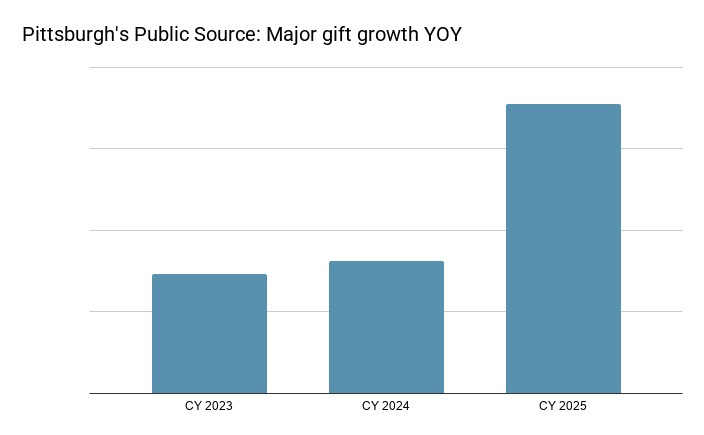
From 2024 to 2025, Public Source increased major donor revenue by 119.2%, with major gifts growing by $100,000 over the course of the year.
It’s been about a year since the Hub and Public Source completed the pilot. Here’s what they learned.
Strategy needs a system
Before the pilot began, Public Source already had many ingredients for a successful donor program: relationships with supporters, a team focused on fundraising, and a clear philosophy about engaging donors.
What it lacked was a system to support that work consistently.
“We would have the ability to execute [major donor work] at certain times,” said Jennie Ewing Liska, Public Source’s co-executive director, revenue and operations. “And then at other times — especially when we got busier with projects or whatever else was going on — some of that process would fall by the wayside.”
The newsroom believed in data-driven practices like cultivation, outreach, and moves management. But without workflows and reporting tools, it was difficult to sustain that work during especially hectic periods.
“There wasn’t a technical backbone or reports and workflows to keep us on track and accountable when times got tough and when we got stretched,” Liska said.
Public Source had long used Salesforce through its partnership with the Hub, but much of the team’s knowledge about donors lived informally rather than inside the system.
“It was all here,” said Paulding, laughing and pointing at their head.
The pilot created space to change that.
The biweekly meetings “gave us an excuse to sit down and have dedicated time to think about this and look at our systems,” Paulding said.
From the Hub’s perspective, Public Source already had the strategy — it just needed infrastructure to support it.
“Public Source had a vision they wanted to execute and a clear idea of how they could get there,” said Sophie Ho, the Hub’s director of product and insights. “And they wanted the extra support — the infrastructure behind it — and that’s where we came in.”
Together, the teams translated that vision into practical systems inside Salesforce, including donor segmentation, prospect tracking, and engagement workflows.
That combination — Public Source’s operational expertise and the Hub’s systems thinking — makes the collaboration especially effective, Ho said.
Those systems continue to shape the team’s work today, helping ensure that major donor outreach remains consistent — even during busy newsroom periods.
Small operational changes can make a big impact
One of the first steps of the pilot was helping Public Source define key donor categories — such as major donors and major donor prospects — and embedding those definitions into Salesforce.
Using indicators like giving thresholds and wealth screening scores, the Hub helped configure the system so potential major donors could be automatically flagged.
From there, the teams built engagement workflows to guide outreach.
If a donor met certain criteria, it would trigger a series of tasks — such as scheduling a phone call or meeting. The goal was to create a structured process for what fundraisers call moves management: cultivating relationships that can eventually lead to major gifts.
“Salesforce is really powerful for teams like Public Source who are trying to take that strategy to the next level,” said Ho. “Automating tasks and assigning it to someone seems small, but it’s an example of a system that builds over time.”
The Hub also helped ensure donor information lived in one place. Instead of tracking conversations in personal notes or spreadsheets, the team could record interactions directly in Salesforce, creating a shared history of each relationship.
Public Source’s fundraising team had worked in Salesforce for years, but the Hub helped bring a higher-level strategic perspective.
“You really cannot use Salesforce without having a partner like the Hub,” said Liska. “You need someone who understands the back end — someone who knows the data structure and can say, ‘I know you think you want to do it that way, but actually if we just opened up this other field over here, it already exists and it’s way easier to do it.’”
Major donor work is relationship-first
While the pilot focused on systems, the philosophy behind Public Source’s major donor work remained the same: relationships come first.
Rather than approaching donors with immediate asks, the newsroom prioritizes conversations — learning what issues matter most to supporters, and how Public Source’s journalism connects to those interests.
“You literally start by getting coffee with someone and asking: what keeps you up at night?” Paulding said. “And that makes things happen.”
Those conversations help the team understand what motivates supporters and how they might want to engage with the newsroom. Sometimes that leads to financial support; other times it leads to new connections or deeper community insight.
“You definitely want to get to big asks at some point,” Paulding added. “But you can’t go into every interaction with that mindset.”
The systems built during the pilot help the team track and nurture those relationships. Notes, shared interests, and follow-up ideas are recorded in Salesforce, making it easier to continue conversations over time.
In some cases, those relationships evolve into larger commitments.
Several examples came from donors who initially made $5,000 – $10,000 donations to Public Source. As relationships developed, they have turned one-time gifts into recurring quarterly contributions — significantly increasing their long-term support.
“It really is built around relationships and people volunteering to give,” Paulding said.
Capacity matters
At Public Source, three people handle major donor outreach: Liska, Paulding, and editor-in-chief and co-executive director Halle Stockton.
Like many small and nonprofit newsrooms, the team has to balance ambitious fundraising goals with limited staff time and many competing priorities.
The systems developed during the pilot help make the work more manageable, but relationship-based fundraising still requires significant capacity.
“One of the things that struck me with this program is that Public Source had a team that they intentionally made sure had bandwidth to do this work,” Ho said.
That level of planning isn’t always common in an industry where burnout is widespread.
“Seeing how Public Source was so careful and thought through so much of it before they even came to us was really inspirational,” Ho added. “It really makes me think about the work we can do to help teams like theirs.”
Now that the pilot has concluded, the News Revenue Hub is expanding major donor consulting to other clients.
Some newsrooms already have a strategy in place and need help building systems to support it. Others may still be defining what major donor work should look like.
“We want to meet newsrooms wherever they are,” Ho said. “Some have the team, the capacity, and the time. And now they’re looking for ways to build a workflow and infrastructure behind it. Others need help defining the strategy first. We’re excited to support both.”
Interested in strengthening your newsroom’s major donor strategy? Learn more by emailing [email protected].