Mid-year report: Revenue is growing across Hub newsrooms — but long-term success hinges on audience growth
The first half of 2026 brought encouraging fundraising signs for revenue growth across News Revenue Hub client newsrooms.
Across the Hub network, revenue from individual gifts under $10,000 increased 6.63% year over year, with local and regional organizations posting particularly strong gains.
That growth reinforces something we’ve seen consistently in our work: When newsrooms build strong relationships with their audiences, those relationships can become increasingly valuable over time. Existing supporters renew, become recurring donors, increase their gifts and, in some cases, develop into significant mid-level and major supporters.
Our mid-year data also points to the next opportunity for growth.
While revenue increased, first-time gifts declined nearly 11% across the network. Regional organizations bucked that trend, growing both revenue and new-donor acquisition, while local and national organizations saw fewer new donors enter the pipeline.
The takeaway isn’t that audience revenue is weakening. It’s that newsrooms are demonstrating they can generate more value from the audience relationships they’ve already built. The opportunity now is to bring more people into those relationships.
That makes audience and donor acquisition an important growth opportunity heading into year-end — and a reminder that sustainable revenue growth starts well before the fundraising ask.
How we analyzed the data
We analyzed January 1 – June 30 year-over-year fundraising trends across 51 News Revenue Hub organizations, including four journalism support organizations.
Unless otherwise noted, our analysis focuses on revenue from individual gifts under $10,000. This allows us to look more closely at audience revenue and small- and mid-level donor behavior rather than the impact of a handful of large gifts.
High level takeaways
Revenue grew across every cohort
Revenue from gifts under $10,000 increased across local, regional and national Hub organizations during the first half of 2026.
Local organizations saw the strongest growth, with revenue increasing just over 10% year over year. Regional organizations followed closely at 9%, while national organizations saw more modest growth of 4%.
Across the full Hub network, revenue increased by nearly 7%.
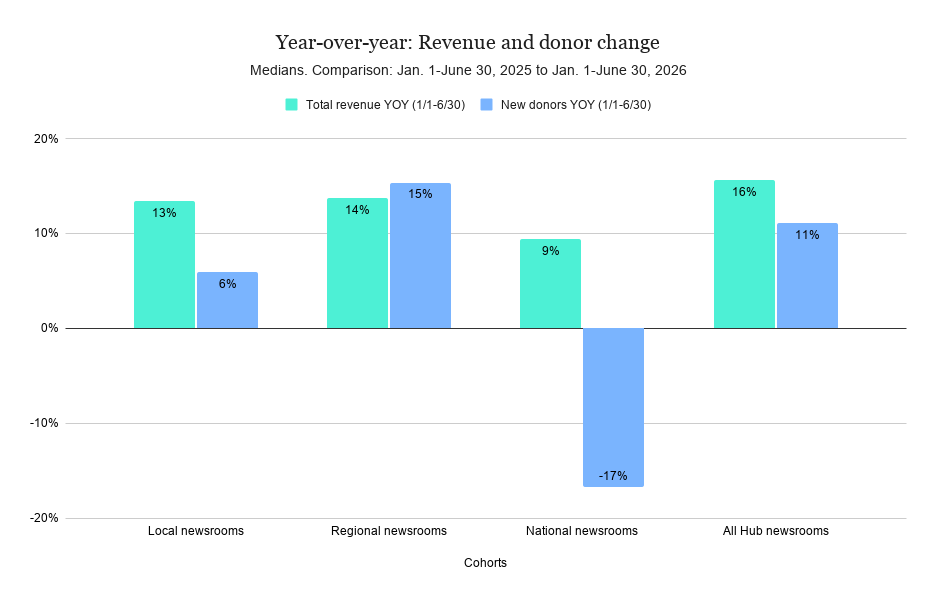
The continued growth in revenue suggests that audiences are still willing to financially support journalism. But the decline in first-time donors means organizations may be relying increasingly on people who have already demonstrated their commitment.
That can be a powerful fundraising opportunity — and also creates a need to keep new donor acquisition moving forward.
New-donor acquisition tells a more varied story
The number of first-time gifts declined 11% across the Hub network, but performance varied considerably by cohort.
Regional organizations are showing the strongest balance of growth
Regional organizations stood out as the strongest performers when we looked at both revenue and donor acquisition.
On average, regional organizations increased revenue by 9.19% year over year while increasing first-time gifts by 8.94%.
Strong acquisition at organizations, including Sahan Journal, helped drive this trend, with the Minnesota-based outlet adding 667 first-time gifts year over year.
Local organizations are raising more from fewer new donors
Local organizations increased revenue by an average of 10.36% year over year — the largest revenue increase among the three primary cohorts. At the same time, first-time gifts fell 14.44%.
That creates a risky mismatch: Local organizations are raising more money, but from a smaller pool of new supporters.
This may indicate an opportunity to deepen relationships with existing donors and cultivate more mid-level support. It also raises a longer-term question: If fewer new donors are entering the funnel, where will tomorrow’s donor base come from?
We saw a similar pattern in our 2025 fundraising analysis, when we noted that revenue growth was increasingly being driven by existing donors rather than first-time supporters.
National organizations face the biggest acquisition challenge
National organizations saw the weakest revenue growth of the three primary cohorts, with average revenue increasing just 4.41% year over year.
At the same time, first-time gifts fell 23.28% — the steepest decline of any cohort.
That combination makes donor acquisition an especially important area of focus for national organizations.
National newsrooms may not have the same geographic identity or sense of place that local and regional organizations can draw on. But the regional results suggest there may be lessons worth borrowing: How can national organizations create a stronger sense of community, belonging, and shared purpose around their journalism?
What the data tells us
The first-half results reinforce something we’ve been watching across the Hub network: existing donors are doing a lot of the heavy lifting.
That’s not necessarily bad news. Loyal supporters are incredibly valuable, and there are meaningful opportunities to deepen those relationships — through renewals, monthly giving, donor upgrades and major-member cultivation.
But a healthy revenue program needs both ends of the equation: retaining the people who already support you and continually bringing new people into the fold.
The first half of 2026 suggests that many organizations have room to strengthen that second piece.
Here are a few places to focus in Q3 and during year-end fundraising:
Pay attention to the top and the middle of the funnel
Think about the entire reader journey — and all the places where someone might encounter your journalism before they ever see a traditional donation appeal. When and where are you asking people to take the next step?
For example:
- Are you making clear donation asks around high-value resources, such as voter guides?
- Are you using breaking-news moments to explain why your journalism matters and why readers should support it?
- Are you making the case for newsletter subscribers who haven’t yet donated?
- Are you following up with people who are lapsing or recently lapsed, who already have a demonstrated relationship with your organization?
- Are you creating pathways for event attendees, podcast listeners, YouTube subscribers and other audiences to become donors?
Don’t assume that because someone is engaged, they know how to support you. Make the next step clear.
Make new donor acquisition a Q3 and year-end goal
If first-time donors are declining, it may be worth making acquisition an explicit goal for Q3 and year-end rather than hoping new donors will emerge from broader fundraising efforts.
That could mean:
- Running a dedicated first-time donor mini-campaign
- Setting a specific new-donor goal alongside your overall revenue goal
- Testing more targeted acquisition asks across newsletters, websites and social channels
- Experimenting with lower-barrier entry points, such as smaller default gift amounts, for audiences who have never donated
- Using matching gifts, giveaways or other special initiatives to bring new people into the donor pool
And remember: lowering the barrier to giving doesn’t mean undervaluing your journalism! The goal is to give someone who hasn’t supported you before a clear, easy way to say yes.
Keep investing in the donors you already have
If existing donors are generating a growing share of revenue, make sure you’re doing everything you can to keep them.
That means focusing on:
- Renewing lapsing and lapsed donors
- Converting one-time donors to monthly sustainers
- Increasing monthly or annual gifts when appropriate
- Identifying donors who may be ready for a larger contribution
- Building stronger cultivation and stewardship programs for your most engaged supporters
For local organizations in particular, the combination of revenue growth and declining new-donor acquisition may point to an opportunity to cultivate more mid-level or “major member” support from the donors already in your orbit.
For national organizations, look for ways to “go local”
Regional organizations are currently showing the strongest balance between revenue growth and new-donor acquisition. That doesn’t mean every newsroom should try to become a local news organization.
But national organizations can ask what makes local and regional journalism compelling to its supporters: community, identity, belonging and a clear connection between the journalism and the people who support it.
A national newsroom might focus on a particular community of interest, a shared mission or a specific problem its audience is uniquely invested in. The goal is to make the value proposition feel less abstract — and the relationship between the audience, the journalism, and the donor more tangible.
Looking ahead to the second half of 2026
The first half of the year gives us reason to be encouraged: Revenue from gifts under $10,000 is growing across the Hub network, even as the fundraising environment remains competitive.
But the decline in first-time donors is a signal we shouldn’t ignore. The opportunity for the rest of 2026 is to build on the strength of existing donor relationships while putting more intentional energy into bringing new people into those relationships.
Sustainable audience revenue isn’t just about getting today’s donors to give again. It’s about building a community of people who understand the value of your journalism — and creating clear, compelling ways for more of them to support it.
That’s the work we’ll be continuing with Hub organizations throughout the second half of 2026.
What’s next:
- If you’re interested in reaching and developing loyalty with new audiences beyond your website and newsletters, sign up for our Civic Studio program and learn how to develop smart vertical video strategies!